



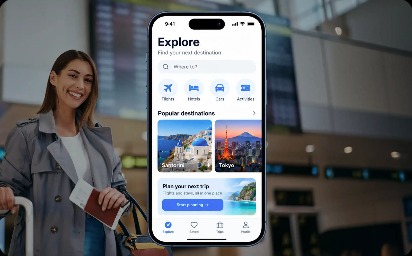
Travel and hospitality apps cover a lot of ground. A boutique hotel that wants guests to check in from their phone has very different needs from a company building a multi-city booking marketplace. That is why you will see quotes ranging from a few tens of thousands of dollars to several hundred thousand for what sounds like the same thing.
This guide breaks the cost down in plain terms: what you are paying for, what pushes the price up or down, and how to plan a realistic budget before you talk to any development team.
Typical cost ranges by app type
| App type | What it usually includes | Typical range (USD) | Typical timeline |
|---|---|---|---|
| MVP or single-property companion app | Guest profile, booking requests, push notifications, simple admin | $25,000 – $50,000 | 2 – 4 months |
| Mid-size booking or tour app | Search and filters, payments, reviews, maps, itinerary, admin dashboard | $50,000 – $120,000 | 4 – 7 months |
| Marketplace or OTA-style platform | Multi-vendor inventory, real-time availability, third-party APIs, loyalty, analytics | $120,000 – $300,000+ | 7 – 12+ months |
Most first-time founders land in the middle row. The key is deciding what must be in version one and what can wait.
What actually drives the cost
- Platforms. iOS only, Android only, or both plus a web app. Cross-platform frameworks such as Flutter or React Native let one team build for both phones from a largely shared codebase, which usually reduces cost compared with two separate native apps.
- Feature scope. Every feature adds design, development and testing time. Real-time availability and payments cost far more than a static list of destinations.
- Integrations. Connecting to hotel property management systems, channel managers, flight or hotel inventory providers, maps and payment gateways is often the biggest hidden driver, because each one has its own rules and edge cases.
- Design complexity. A clean, standard interface is faster to build than a heavily custom, animation-rich experience.
- Backend and scale. Supporting a few hundred users and supporting hundreds of thousands need different architecture, hosting and monitoring.
- Compliance and security. Handling payments and personal data means following data-protection rules such as GDPR and using certified payment providers rather than storing card details yourself.
- Team location and model. Hourly rates vary widely by region, and a dedicated team costs differently from a project-based engagement.
Core features and how they affect your budget
Not all features are equal. Here is how common ones tend to land:
- Lower effort: user accounts, profiles, push notifications, saved favourites, basic content pages.
- Medium effort: search and filters, reviews and ratings, maps and location, itinerary management, multi-language support.
- Higher effort: real-time availability and inventory sync, in-app payments with refunds, multi-currency pricing, loyalty programmes, dynamic pricing, offline mode.
Extra considerations for hospitality apps
If you run hotels, resorts or serviced apartments, guests expect more than booking. Digital check-in, mobile keys, in-stay requests such as housekeeping or room service, and spa or restaurant reservations are all common asks. Most of these depend on connecting to your property management system, so check what integrations it supports early, because that can shape both the budget and the timeline.
Hidden costs people forget to budget for
- Third-party fees. Maps, SMS, payment processing and booking APIs often charge per use or per month.
- Cloud hosting. Servers, databases, storage and monitoring are recurring costs that grow with your users.
- App store accounts. Apple and Google both charge developer account fees, and both take a commission on certain in-app purchases.
- Maintenance. Operating system updates, bug fixes and small improvements are ongoing. A common rule of thumb is to set aside roughly 15 to 20 percent of the original build cost each year.
- Launch and marketing. An app does not get downloads by existing. Plan for acquisition, onboarding and support.
- Legal and policy work. Privacy policy, terms of use and supplier agreements.
How long does it take?
A typical project moves through discovery and planning (two to four weeks), UX and UI design (three to six weeks), development in sprints, quality assurance, and launch. Simple apps can reach the stores in a few months. Complex platforms with many integrations often take close to a year, and they continue to evolve after launch.
Smart ways to keep the cost under control
- Start with an MVP. Launch the smallest version that proves guests or travellers want it, then expand based on real usage.
- Go cross-platform. Unless you need deep native features, one shared codebase is usually the efficient choice.
- Use proven services. Reuse established payment, maps and messaging providers instead of building them from scratch.
- Prototype first. A clickable prototype lets you test flows with real users before development begins, which is much cheaper than changing finished code.
- Phase the roadmap. Split the build into releases so you can adjust budget and priorities as you learn.
Getting an accurate estimate
The fastest way to turn a range into a real number is to write down who your users are, the three to five things they must be able to do in the app, and which systems it has to connect to. With that, a development team can scope the work properly and give you a clear breakdown of cost and timeline.
If you are planning a travel or hospitality product, our team can help you shape the scope, choose the right technology and build it in stages. Use the form below and tell us about your idea.